Home
Comedy
Drama
War
Thrillers
Film Noir
Romance
Horror
Sci-Fi
Christmas
Modern

Paths of Glory
1957 movie


Paths of Glory movie poster

If you haven't seen it:
Paths of Glory is set in France during World War One. The French and the Germans are in a stalemate position - both have dug themselves into well-defended trenches, and they face each other across no-mans-land.

Determined to break the deadlock, the French generals order their troops to make an all-out attack on the Germans, even though they know that it will result in the slaughter of thousands of their own men. Kirk Douglas plays the colonel who has to lead his men over the top.

Paths of Glory was directed by Stanley Kubrick, one of the greatest directors of all time. Some critics have claimed that he made the best ever horror movie (The Shining), the best ever sci-fi movie (2001: a space odysey), the best ever historical epic (Spartacus), and the best ever comedy about thermonuclear war (Dr Strangelove). He also made the amazing Full Metal Jacket, but many believe it was with Paths of Glory that he made the best ever war movie.

If you have seen it:
Scroll down past the adverts and the trailer for more.


Click below to watch the trailer:
(If you cannot see the trailer below, your browser may need adjusting)
SPOILER ALERT: The plot summary and comments below contain details that might spoil your enjoyment of Paths of Glory if you have not already seen it.


Plot:
Paths of Glory begins with a meeting between two French generals. The more senior officer, General Broulard, is trying to persuade the other, General Mireau, to order his men to attack the notoriously impregnable German stronghold known as "the ant hill". He does this by implying Mireau will be rewarded with honors and a promotion, and even though Mireau knows most of his men will be killed, he allows himself to be persuaded.

On the day of the attack, French artillery start firing upon the German position to provide cover for the infantry attack, but the shelling just alerts the Germans that an attack is imminent, and they respond with artillery and machine-gun fire of their own. Hundreds of French soldiers, led by Colonel Dax (Kirk Douglas), advance through no-mans-land, and most are killed. The other half of the regiment though, led by Lt. Roget (who appears to be drunk) have not left the trenches at all, because they are pinned down by enemy fire. When General Mireau sees that some of his men have not joined in the attack though, he orders the French artillery to open fire on his own men - but the artillery commander refuses to accept the order unless it is put in writing. Eventually, the whole assault on the ant hill is abandoned. Furious, Mireau demands that his men be shot for cowardice, and three men are selected as scapegoats; they are arrested and sent to be court-martialed.

Paths of Glory movie
Out of the frying pan, into the...

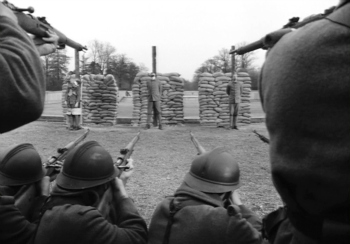
Dax, who was a top criminal lawyer before the war, insists on defending the men himself. Despite his powerful defence though, they are found guilty and sentenced to death. Dax attempts to cajole General Broulard into intervening by threatening to go public with the fact that Mireau ordered the attack on his own men. Broulard however, allows the execution to go ahead, and tries to placate Dax by offering him a promotion. Dax angrily refuses, so he is ordered to go back to the front.

Steve Sunday says:
The enemy in this film are not the Germans, but the incompetent, sadistic, and self-important French generals. In fact, we never actually see a German soldier in the whole course of the movie. Anyone who has studied World War 1 will know that trench warfare was horrific, and that the generals on both sides were to blame for millions of unnecessary deaths, but it is still shocking to see it portrayed on screen so convincingly.

Paths of Glory movie
Goddammit - for the last time, I'm Spartacus!

In this movie, Dax is of course, a noble and heroic figure. I could not help but wonder though if Paths of Glory would have been an even more powerful film if Dax had in fact accepted the promotion at the end. After years of the living hell of the trenches, would we have blamed him for taking the easy way out? Could Kubrick have let him sell his soul but still remain a sympathetic character? Just an idea.


Trivia Trish says:
  • The title is a quotation from Thomas Gray's poem Elegy written in a country churchyard - "The paths of glory lead but to the grave".
  • Kubrick originally intended to give the story a happy ending, but after several draft scripts he changed his mind and restored the novel's original bleak ending. Fearing that the studio would reject this change, the producer had the final script delivered to them without mentioning the changes, and assumed, correctly, that nobody in the studio would actually read it.
  • Paths of Glory was banned in many countries for its negative portrayal of the military, including France, Switzerland, Germany, and Spain.
  • Kubrick later married Christiane Harlan, the girl who performs the singing at the end of the film. They remained married until his death in 1999.
  • The trenches in the movie are actually two feet wider than the original World War I trenches to allow room for the roving camera dollies.
  • Winston Churchill once spoke about the film, saying he believed it was a highly accurate depiction of trench warfare and the sometimes misguided workings of the military mind.


Paths of Glory movie
The Trench Revolution


Main cast & crew:
Kirk Douglas ... Col. Dax
Ralph Meeker ... Cpl. Philippe Paris
Adolphe Menjou ... Gen. George Broulard
George Macready ... Gen. Paul Mireau
Director: Stanley Kubrick


HTML Comment Box is loading comments...


Back to War Movies from Paths of Glory

Black and White Movies Homepage - Home of Classic Old Movies


Follow us on:
Follow Movies_Movies on Twitter


About Us

Contact Us

Links